Public and Private Experts’ Cross Evaluation of Sustainable Developments in the Context of Parking
Editie: 33- Public vs. Private
Published on: 15 november 2026
- Introduction
Over the years, parking has been acknowledged as an important regulator in creating a sustainable urban environment and transportation system (e.g. Smith and Sarasini, 2025). Parking policy regulates mobility, provides services to customers, shapes the urban environment, and sets the framework for governments’ and investors’ revenues (e.g. Litman, 2025). These goals of parking policy may result in differences of interest between policy makers (mainly municipalities) and commercial parties. For example, differences in interests can exist between policymakers aiming to reduce car use and parking operators aiming to optimize revenues. In the context of parking and mobility, stakeholders can be determined based on their backgrounds: governmental, commercial, or society-based. Governmental organizations develop and enforce parking policy. Commercial parties invest and deliver products and services for the government and society. Society can be considered as a key user of the built environment (CROW, 2012). More specifically, governmental (public) and commercial (private) parties perform activities in the field of parking and are considered as most relevant stakeholders.
When looking at decision processes in the context of parking, the relationship between the knowledge levels of experts from the public and the private sector is still vague (Beetham et al, 2014; Johansson, 2024). This is especially true for insights into each other’s viewpoints regarding future developments. For experts from both sectors, it is challenging to get a clear view of the potential of future developments. Both groups of experts know what is going on in practice but find it very difficult to assess the most potential development for their organization (Mingardo et al, 2015). The question is which developments in the public and private sectors have to focus on with their efforts and investments. This question showed the need to investigate the potential of various sustainable developments in the context of parking in more detail.
This article describes the findings of a ‘cross’-evaluation conducted by experts from the public and private sectors. The aim of this cross-evaluation is to find out if one group of experts is able to assess in what way the other group of experts evaluates sustainable developments. The study presented in this article is an extension of the study of Weterings (2013) on decision making process of stakeholders regarding developments in the context of sustainable parking. Weterings (2013) focused on the selection of promising developments based on stakeholders’ expectations. Based on a multi-criteria analysis including an Analytical Hierarchy Process (AHP) approach, he composed a ranking of investigated developments. It appeared that both the public and private sectors have the highest expectation regarding ‘the introduction of electronic navigation, wayfinding and payment system’. This development is followed by ‘the introduction of flexible parking standards’ (in the case of public sector) and ‘the improvement of the sustainability of existing parking stock’ (in the case of the private sector).
The remainder of the article is organized as follows. First, attention is paid to the investigated developments and the criteria that are used to evaluate the developments (section 2). In section 3, some details of the data collection are presented. The comparison of evaluation scores between the groups of experts is described in section 4. The paper ends with the conclusions of this study.
- Developments and criteria
A literature review provided a list of sustainable developments in parking (for details see Weterings, 2013). The developments are categorized by type of sustainable development:
- Improving the sustainability of the existing parking stock;
- Developing charging networks for electricity driven vehicleselectric vehicles (EVs);
- Introducing electronic navigation, way finding, and payment systems;
- Increasing number of P+R and K+R areas in order to support Car-Sharing;
- Introducing policy in order to enable flexible parking standards; and
- Increasing number of functional changes in the inner city built environment as a result of demographic change and internet shopping.
Multiple decision criteria are available that represent stakeholders’ incentives, sustainable goals in society, and presumed effects of developments. In this research, potential sustainable developments are evaluated to find differences and similarities in viewpoints of stakeholders. Selection rules are used to find the most important criteria involved in the assessment of the developments in parking: criteria should be applicable to evaluate all types of developments; criteria represent incentives of both stakeholder groups; and vagueness of criteria has to be prevented (Table 1).
Payoff and outcomes of developments related to the decision criteria can be divided as impacts and effects. Impact criteria are used to describe the impact on the stakeholders’ business plan: the ‘financial aspects’ and ‘control aspects’ that may be affected by the developments. On the other hand, effect criteria, are used to describe the outcome of a development regarding mobility and sustainability.
Table 1. Detailing of investigated criteria
| Criteria | Sub-criteria |
| Impact on business plan: financial aspects |
Investment costs for organization ROI for organization Risk for organization |
| Impact on business plan: control aspects |
Influence of organization on development Influence of development on business plan |
| Impact on mobility aspects |
Effect of parking demand city center Effect on congestion city center |
| Impact on sustainability aspects |
Effect on energy usage Effect on amount of kilometers travelled Effect on amount of pollutants (CO2, NOX) |
- Data collection
In an online survey, experts of the selected stakeholder groups were invited to evaluate the developments (Figure 1). First, the experts were asked to evaluate the six developments from the perspective of their own organization. In addition, they were invited to evaluate the developments from the perspective of the other group. The evaluation of the various aspects was performed using a three point scale ranging from ‘low/small’ to ‘high/big’ for impact related aspects and ‘decrease’ to ‘increase’ for the effect related aspects. The questionnaire also included questions regarding expert’s background, pairwise comparison of aspects, and propositions concerning sustainability and innovation.
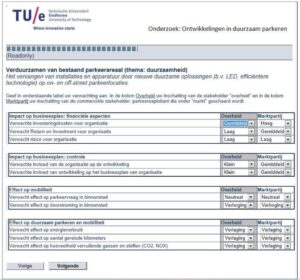
Figure 1 Part of the online survey, existing parking stock (Weterings, 2013)
In total, 35 experts from various organizations participated in the study. The experts were personally invited through email and/or telephone calls. The experts are equally distributed across public (51%) and private (49%) sector, and across type of activity they are involved in: tendering and management. The experts operate mainly at the local (40%) and/or national level (51%).
- Analyses
The evaluation scores of one group (their thoughts) are compared with the evaluation scores provided by the counter group (their reality) using a three dimensional chi-square-test (aspects × evaluation scores × stakeholder). The results of the tests are presented in Table 2. The number of degrees-of-freedom is equal to 18 (9 × 2 × 1). At the 95-percent confidence level, the test-value of Chi-Square is equal to 28.87. A significant difference in point of view is found for the evaluation of development (iii) ‘introduction of electronic navigation, way finding, and payment’ (for public sector evaluating private sector). Table 3 presents the medians of the observations. The experts of the public sector think differently at the control aspects and mobility aspects. In frequency, the largest difference is found for the aspect ‘influence of organization on development’.
Table 2. Results of three dimensional chi-square tests
|
Developments |
Public thought versus Private reality | Private thought versus Public reality |
|
Sustainability of existing parking stock Charging networks for electric cars Electronic navigation, way finding, payment system Number of P&R/K&R to support car sharing Flexible parking standards Functional changes on Inner-city areas |
22.65 21.05 37.71 6.95 17.33 11.86 |
37.03 23.29 26.90 12.88 29.87 13.83 |
|
Degrees-of-Freedom Test-value Chi-Square |
18 28.87 |
|
Table 3. Median evaluation scores for ‘the introduction of electronic navigation, etc.’
|
Evaluation aspect |
Public sector’s thought | Private sector’s reality |
Financial aspects
Control aspects
Mobility aspects
Sustainable aspects
|
Medium Medium Medium/High
High Low
Neutral Neutral
Increase Increase Increase |
Medium Medium Medium
Medium Low/Medium
Neutral/Increase Decrease
Increase Increase Increase |
| Number of observations | 18 | 17 |
Looking to the private sector’s thoughts regarding the evaluation scores of the public sector, it appears that there are significantly different points of view for developments ‘the improvement of the sustainability of existing parking stock’ and ‘the introduction of flexible parking standards’ (for private sector evaluating public sector). For the development of sustainability, it appears that the viewpoints differ across almost all aspects. In frequency, the largest difference is again noticed for the aspect ‘influence of organization on development’. In the case of flexible parking standards, the differences in viewpoints occur on financial and control aspects. In frequency, the largest differences are found for the aspects ‘impact on investment costs’, ‘effect on energy usage’, ‘effect on amount of car kilometers’, and ‘effect on amount of pollutants’.
- Conclusions
This study focused on the perception of one group of experts regarding the evaluation scores of another group of experts (cross evaluation). The findings of this study show that there are still some differences in what one group ‘thinks’ and what the other groups’ ‘reality’ is. This is especially true for the expectations regarding the introduction of an electronic navigation, way finding, and payment system; the improvement of the sustainability of existing parking stock; and the introduction of flexible parking standards. For both stakeholders groups, it is important to clarify their expectations to each other and become more familiar with each other’s business processes (financial and control aspects). This clarification can help to set up joint strategies for developments and implementation of sustainable parking measures and reduce delays in implementation (Jittrapirom et al, 2021). For example, the introduction of electronic navigation and wayfinding for reducing car kilometers (public sector) in cities should be guided by measures to keep parking facilities profitable (private sector). In this way, discussions about the introduction could be limited.
To stimulate respondents to participate in the study, the list of investigated developments was limited. Additionally, some specific measures were combined in more general developments. In future research, more detailed descriptions of the developments are required to improve the experts’ general understanding of the aspects of the developments. The evaluation of the developments was carried out using different aspects assuming that all stakeholders are able to evaluate the same aspects. The level of knowledge of and experience with the investigated aspects might not be equal for different stakeholder groups. This assumption has to be investigated in more detail in future research by measuring the experts’ level of knowledge and experience concerning the investigated aspects.
About the author: dr.Ing. Peter J.H.J. van der Waerden
|
Peter van der Waerden studied Transportation at the National Academy of Planning, Transportation and Logistics in Tilburg and Human Geography at Utrecht State University. Since 1986, Peter is a lecturer/researcher at the Urban Planning and Transportation group of Eindhoven University of Technology, the Netherlands. Peter provides education in Transportation Engineering and Geographic Information Systems. Peter’s main research areas concern the design and use of car, cycling, and pedestrian facilities with a focus on the relationship between these facilities and people’s travel decisions.
|
 |
References
Beetham, I.F., Enoch, M.P., Tuuli, M. & Davison, L.J. (2014) Stakeholder Perspectives on the Value of Car Parking, Urban, Planning and Transportation Research 2, 195-214.
CROW (2012) Guidelines for Parking (in Dutch), Ede, the Netherlands
Jittrapirom, P., Boonsiripant, S. & Phamornmomgkhonchai, M. (2021) Aligning Stakeholders’ Mental Models on Carsharing System using Remote Focus Group Method, Transportation Research Part D 101, 103122.
Johansson, M. (2024) Parking for Sustainable Cities; How to understand innovative Parking Development, Department of Service Studies, Lund University, Lund, Sweden.
Litman, T. (2025) Parking Management, Comprehensive Implementation Guide, Victoria Transport Policy Institute, Vancouver, Canada.
Mingardo, G., Van Wee, B. & Rye, T. (2015) Urban Parking Policy in Europe: A Conceptualization of Past and Possible Future Trends, Transportation Research Part A 74, 268-281.
Smith, G. & Sarasini, S. (2025) Municipally owned Companies and Sustainability Transitions: Examining Municipal Parking Companies’ Roles in Governing Mobility Transitions, Environmental Innovation and Societal Transitions 57, 101036.
Weterings, N.P.A. (2013) Towards Sustainable Parking: Decision Making of Governmental and Commercial Stakeholders, Master thesis Construction Management & Engineering, Faculty of the Built Environment, Eindhoven University of Technology, Eindhoven, the Netherlands
Mail the editors